Do I Need a Grill Cart?
Recommended picks
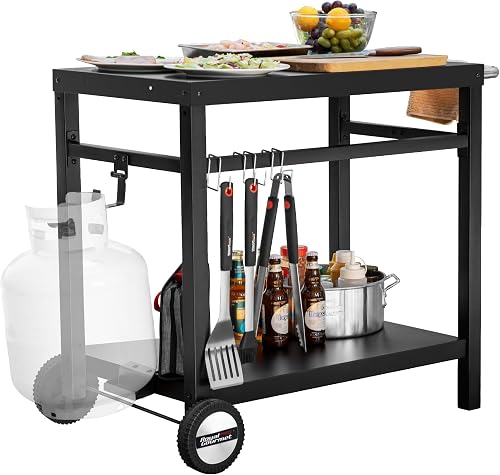
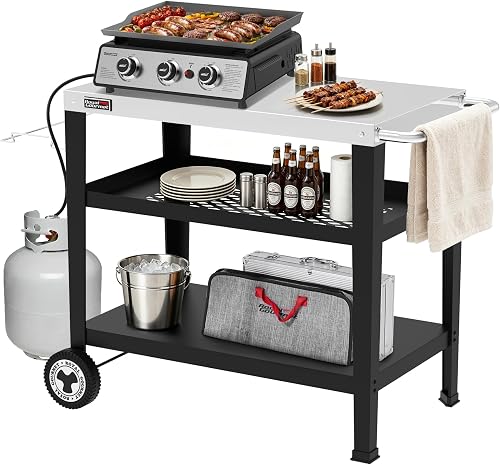

What a Grill Cart Actually Does for You
A grill cart is a freestanding table or cabinet on wheels designed to sit beside your grill and serve as a prep and staging station. Most models offer a flat work surface, one or two lower shelves for propane tanks or charcoal bags, and hooks on the sides for hanging tongs and brushes. The wheels let you reposition everything without disassembling your setup. For anyone cooking for four or more people, having that extra surface nearby means less time running back and forth to the kitchen and more time managing the actual cook.
Who Needs One Most
If your grill is a freestanding model with no side shelves, a cart is a near-necessity rather than a luxury. The same goes for anyone using a kettle grill or a kamado that sits on its own stand with no storage underneath. Renters and people who grill on a patio or balcony with no permanent prep counter also get clear value from a cart. If you host regularly and find your patio table constantly taken over by raw meat, rubs, and platters, a dedicated cart keeps things organized and gives your guests their table back.
Material and Build: What to Look For
Alloy steel and iron frames are the most common and hold up well outdoors when kept under a cover. The Royal Gourmet PC3401B, for example, uses an alloy steel frame and weighs 27.1 lb, which is light enough to move around but sturdy enough to hold a full set of tools and a couple of platters. The Feasto 734401B steps up to an iron and stainless steel combination at 34.1 lb, which adds rigidity if you plan to load it heavy. For the tabletop specifically, stainless steel is the most practical choice: it cleans up fast, resists rust, and handles hot pans without warping. The Royal Gourmet PC3404S addresses this directly with a stainless steel tabletop over an alloy steel frame, and at $88.13 with a 4.7-star rating across 838 reviews it represents a practical middle-ground option.
Size and Footprint
Cart dimensions vary more than most buyers expect. The Royal Gourmet PC3401B runs 23.23 x 39.57 x 31.89 inches, giving you about 39 inches of working width without taking over a tight patio. The Feasto 734401B is slightly larger at 25.6 x 39.5 x 33 inches, and the Royal Gourmet PC3404S stretches to 23.82 x 45.98 x 31.73 inches for more counter length. Before buying, measure the gap between your grill and the nearest wall or fence. You want the cart to sit flush to the grill side without blocking foot traffic. Working height around 30 to 34 inches suits most adults standing at a grill.
Cart vs. Built-In Side Table vs. Outdoor Kitchen
A cart costs $80 to $200 for a solid mid-range option and you take it with you if you move. A built-in outdoor kitchen is permanent, costs far more, and only makes sense if you own your home and grill several times a week year-round. If your grill already has a side table, check whether it is a true flat prep surface or just a flimsy fold-down shelf that wobbles under weight. Many gas grills include side tables that measure only 10 to 14 inches deep, which is enough for a plate but not a full prep station. A cart fills that gap without committing to a permanent structure.
When You Can Skip the Cart
If you already cook on a large gas grill with two wide side tables and cabinet storage beneath the firebox, an additional cart is redundant. Apartment dwellers with a small balcony and a portable tabletop grill also gain little from a full-size cart: the footprint does not make sense for the scale of the cook. And if the only cooking you do is the occasional hot dog or burger for two people, the convenience gain does not justify the purchase or the storage challenge in winter months.
Common mistakes to avoid
- Buying a cart before measuring the patio space, then finding it blocks the door or walkway.
- Choosing a cart with an MDF or wood tabletop instead of stainless steel, which swells and warps in rain.
- Ignoring weight capacity ratings and overloading the lower shelf with a full propane tank plus a bag of charcoal.
- Getting a cart with fixed legs to save money, then realizing you cannot move it when you need to rearrange for guests.
- Skipping a grill cover for the cart itself, letting alloy steel or iron frames rust through a single wet season.
- Buying the cheapest option without checking the shelf clearance height, then finding a standard 20 lb propane tank does not fit underneath.
Frequently asked questions
Can I use a regular utility table instead of a grill cart?
A utility table works in a pinch, but most are not built for outdoor heat and grease. Plastic folding tables can warp or melt if hot cookware is set on them, and they have no hooks or lower storage designed around grilling gear. A purpose-built grill cart is better matched to the job and typically holds up longer outdoors.
Does a grill cart need to match my grill brand?
No. Grill carts are sold as standalone accessories and any cart at roughly the same working height as your grill will function well beside it. The key specs to match are height, so your prep surface is level with the grill side table, and depth, so the cart does not stick out past the grill into your walkway.
How do I keep a grill cart from rusting?
Cover it when it is not in use. Alloy steel and iron frames will surface-rust within one wet season if left exposed. A fitted grill cover or a generic outdoor furniture cover slows that down considerably. Wipe down the tabletop after every cook to remove grease, which holds moisture against the metal and speeds corrosion.
What is a reasonable budget for a grill cart?
For a functional alloy steel or iron cart with a decent-sized work surface, expect to spend $80 to $130. The Royal Gourmet PC3401B comes in around $85.99 with over 6,800 reviews at 4.5 stars, which is a reliable entry-level reference point. Carts in the $120 to $250 range typically add stainless steel tabletops, heavier gauges, or larger footprints. Anything above that is generally moving toward commercial or outdoor-kitchen-grade builds.
Do grill carts come assembled or do they require tools?
Most mid-range carts ship partially disassembled and require 30 to 60 minutes of assembly with basic hand tools. The hardware is usually included. Read the assembly reviews specifically before buying: a well-designed cart with clear instructions goes together in one session, while a poorly documented one can take twice as long. Questions about assembly can be directed to hello@thebbqgrill.com.