How to Choose a Grill Cover That Actually Fits and Lasts
Recommended picks

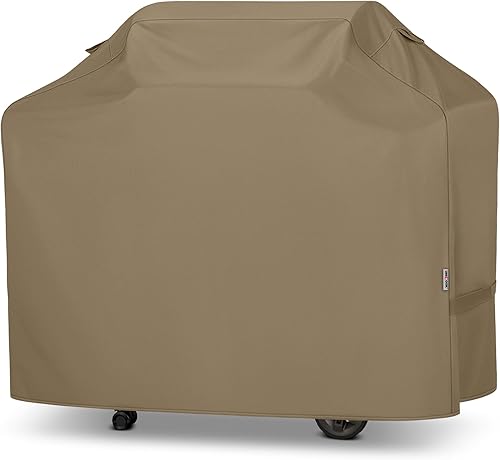

Measure Before You Buy
Pull out a tape measure and record your grill's length, depth, and height with the lid fully closed. If your grill has folding side shelves, measure with them folded down since that is the position the cover will sit in most of the time. Add 2 to 3 inches on the length and depth so the cover drapes past the bottom rail, which keeps wind from lifting it. Height is the most overlooked number: a cover that is too short exposes the lower cabinet to rain. The Unicook B600701T, for example, comes in at 55 x 23 x 42 inches and is designed for mid-size three or four burner gas grills in that footprint range.
Cover Materials Compared
Polyester by itself is light and cheap but not very water-resistant on its own. Better covers laminate or coat the polyester with vinyl or PVC to create a water-shedding outer layer. The Unicook B600701T uses polyester with a vinyl coating, and it carries a 4.7-star rating across more than 6,300 reviews, which suggests the coating holds up through real outdoor use. The Utheer 001, also rated 4.7 stars over 8,112 reviews, is another polyester-based option in the same budget range at $26.99. PVC-only covers are stiffer and crack in hard freezes, so they are a better fit for mild climates. Stanbroil and Ultcover both use oxford-weave or PVC-coated polyester blends that stay flexible in cold weather better than straight PVC.
Vent and Drawstring Features
Air vents near the top of a cover matter more than most buyers expect. Without them, heat from a recently used grill gets trapped inside, and condensation builds up overnight. That moisture accelerates rust on the firebox, burner tubes, and cooking grates. Drawstrings or elastic hems at the bottom keep the cover from blowing off in wind without requiring so much tension that you fight the cover every time you want to cook. Velcro side straps add a second line of defense on covers meant for exposed or coastal yards where sustained wind is common.
Grill Type and Cover Shape
Gas grill covers are typically rectangular and designed around the hood profile. Kamado covers are round or oval and sit lower to the ground. Pellet grill covers need extra height clearance at the back for the hopper. The PIT Boss 73821 is a polyester cover sized at 59.5 x 23.75 x 47.75 inches and lists a specific fit for the PIT Boss 75953 smoker. Buying a brand-matched cover like that removes all the guesswork on shape. For off-brand or older grills, a universal cover works fine as long as you verify the three dimensions rather than relying on a vague size label like 'large' or 'fits most grills.'
Climate Considerations
In wet climates like the Pacific Northwest or Gulf Coast, prioritize a waterproof outer shell and a breathable inner liner. A fully waterproof but non-breathable cover traps humidity inside and that moisture has nowhere to go. In snowy climates, look for covers with reinforced seams since snow load and freeze-thaw cycles stress stitching over time. In desert climates, UV degradation is the main enemy: covers with UV-stabilized coatings or darker fabric hold color and structural integrity longer than thin light-colored covers that go brittle after one summer. The Ultcover model uses a 70-percent polyester, 30-percent PVC blend in brown and is rated 4.8 stars across 2,400 reviews, suggesting it performs across a range of outdoor conditions.
Price and How Long to Expect a Cover to Last
Budget covers in the $20 to $35 range, including options from Utheer and Unicook, are a practical choice if you plan to replace the cover every two to three seasons, or if your grill lives in a mild, dry climate. Mid-range covers from $35 to $60 tend to use heavier-denier fabrics and reinforced handles. Above $60 you typically get commercial-grade materials, double-stitched seams, and extended manufacturer support. No cover lasts forever outdoors, but storing the cover in a garage or shed during winter extends its life considerably regardless of the price point. Contact us at hello@thebbqgrill.com if you have questions about a specific cover or grill pairing.
Common mistakes to avoid
- Buying by grill size label (small, medium, large) instead of measuring actual dimensions in inches.
- Putting the cover on while the grill is still warm, which traps steam inside and promotes rust.
- Choosing a cover with no air vents, so condensation builds up underneath overnight.
- Picking straight PVC in a cold climate where it stiffens and cracks at freezing temperatures.
- Using a cover that is too long or too wide so wind catches it like a sail and flips it off.
- Never cleaning the cover, which lets mildew grow on the interior liner and transfer to the grill.
Frequently asked questions
Should I cover my grill after every use?
Yes, but wait until the grill has cooled down fully, usually 30 to 45 minutes after cooking. Covering a warm grill traps steam and condensation inside the cover, which sits against the metal surfaces and speeds up rust. Once the grill is at ambient temperature, the cover keeps rain, bird droppings, tree sap, and UV exposure off the finish.
How do I know what size grill cover to buy?
Measure your grill's length, depth, and height with the lid closed and side shelves folded down. Use those three numbers to find a cover within 2 to 3 inches of each dimension. Avoid covers that are more than 4 to 5 inches oversized in any direction because excess fabric flaps in the wind. Brand-matched covers, like the PIT Boss 73821 for the PIT Boss 75953, remove all sizing guesswork.
What material is best for a grill cover?
Polyester with a vinyl or PVC coating is the most practical choice for most climates. It is lightweight, flexible in cold weather, and water-resistant. Straight PVC is more rigid and tends to crack in freezing temperatures. Oxford-weave polyester rated at 600D or higher holds up better in high-wind or high-UV environments than thinner fabrics.
How do I keep my grill cover from blowing off?
Look for a cover with a drawstring or elastic hem at the bottom, which pulls snug against the lower edge of the grill cabinet. Velcro side straps add a second anchor point on particularly windy sites. A well-fitted cover that does not have excess fabric hanging loose is less likely to catch wind in the first place, so accurate sizing matters as much as the strap design.
Can I leave a grill cover on year-round?
Yes, a quality cover is made for continuous outdoor exposure. In winter, check underneath the cover every few weeks to make sure condensation is not building up, and wipe down the grill if needed. In peak summer, UV degradation is the main concern, so covers with UV-stabilized fabric will hold up better through multiple seasons than budget covers that use untreated material.